~ Anne Morrow Lindbergh
Buddhism acknowledges impermanence as a way of life. Old time members of Alcoholics Anonymous tout (and rely on) the slogan, "this, too, shall pass." Though I have intellectually understood the idea of change - and, of course, have experienced it for over 46 years - emotionally, at times, I have often fought against this idea with a vengeance: holding on to what I [think I] want, how I would like things to be - often leaving deeply embedded nail marks on people, places, things, and situations, as I have, to no avail, refused to let go.
Over the past couple of years, I have started to release my tight grasp, have begun to let go (or, at least, let be), of what I want or how I think things should be and have started to accept people, places, things, and situations as they are right now. Not always. Not in every moment and not in every situation. But definitely much more often.
This past summer and this new school year have given me the opportunity to practice flowing with impermanence on a very conscious level. First, I graduated in June, and while it has been a luxury to have some extra time and to have the pressure of assignments, papers, and deadlines removed, the loss of the intensity, the intellectual, emotional and spiritual challenges, and the loss (albeit, not completely, just daily) of a close community of people who share a common language and goals has left me feeling a bit hollowed.
I also let go of a relationship that I had been hanging onto two years too long. While I am aware that this is actually a positive change, it has been an adjustment.
This current school year has given me the chance to switch teaching hats. I moved from a full-time 6th grade teacher into the role of Drama teacher, where I spend my days teaching both sixth and twelfth grade students. I have missed having a contained classroom, and have struggled with the transition of teaching older students, who are in many instances, "set in their ways."
However, there have been some lovely moments through all of these changes as well. There is a kind of serenity within that I don't recall having before. I am more want to notice what I am feeling, as well as my responses to different people and situations, with an "Isn't that interesting?" perspective rather than a reactive one. I believe that all my years in AA coupled predominantly with my Naropa education and continuing journey in Buddhist practices are helping me to become much more mindful of who I am and what I am doing in the here and now.
Psychotherapist, writer, teacher and co-founding member of Spirit Rock Meditation Center, Sylvia Boorstein says:
Mindfulness is the aware, balanced acceptance of the present experience.
It isn't more complicated than that. It is opening to or receiving the present moment, pleasant or unpleasant, just as it is, without either clinging to it or rejecting it.
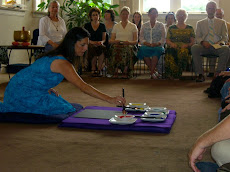
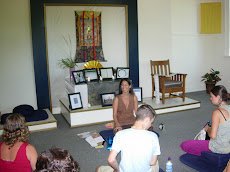
Maintaining my personal ritual practices (i.e. daily meditation, awareness walks with my dog, Love - albeit only about once a week now) since graduation has helped immensely to be sure. Shamatha, in particular, has been a very important component - I believe - in my ability to ebb and flow with daily impermanence, as well as with the "bigger" changes that have come my way.
Also, deepening my practice through the time I spent at Deerpark Monastery, continuing my Shambhala Training (I completed my Level 3 Training a few weeks ago and will be taking my Level 4 Training in November), and also beginning to meet with a monthly sangha meditation group have also helped to keep me balanced when life's winds seem to kick up and throw me a bit off course. I "take comfort" in my continuing practice.

My friend, Debbie, snapped the above photo outside a Starbucks store recently and sent it to my cell phone. It made me smile, as I received it while I was at work and the timing could not have been better. I had been ruminating about my classroom rituals. Last year they were such a meaningful part of my class work. This year, they seem to be practiced more along the lines of routine. I have been wondering if it was the way I introduced them....or if it is the way my students have seemed to only semi-embrace them...or perhaps there is something else that has led me to feeling that the rituals we are practicing don't feel sacred like they did in the past.
However, by simply continuing to practice them, I do take comfort in the rituals themselves. It reminds me of Mother Teresa and how she wrote in her diary and confided in her spiritual counselors that she had experienced the loss of her faith and yet she continued to perform service work and prayer. I am also reminded of my acting training where I was encouraged to be present and to "come from where you are" and at the same time, knowing when it is important to rely on technique.
And yet, I know - I really do know - that this, too, shall pass. My classroom rituals will have meaning again. Or perhaps I will let go of some and add anew. And maybe in being present for the fact that my classroom ritual practices feel a bit meaning-less, I can begin to understand what they might mean on a deeper level. I trust "that nothing is static or fixed," as Pema Chödrön reminds us:
Everything is in process. Everything—every tree, every blade of grass, all the animals, insects, human beings, buildings, the animate and the inanimate—is always changing, moment to moment.
And so it is.